AMINA Onboarding
Designing trust in a regulated onboarding flow for professional investors
AMINA is a regulated digital asset bank serving professional private clients. As Lead Product Designer, I led the design of the onboarding and identity verification experience.
This case study examines how trust was established at multiple points across the journey — from legitimacy signalling to identity checks and on-chain disclosures — within a compliance-driven environment.
Details are presented at a high level due to confidentiality.
Context
AMINA decided to move onboarding in-house, replacing an external service provider. This created an opportunity to reassess the end-to-end onboarding journey without vendor constraints.
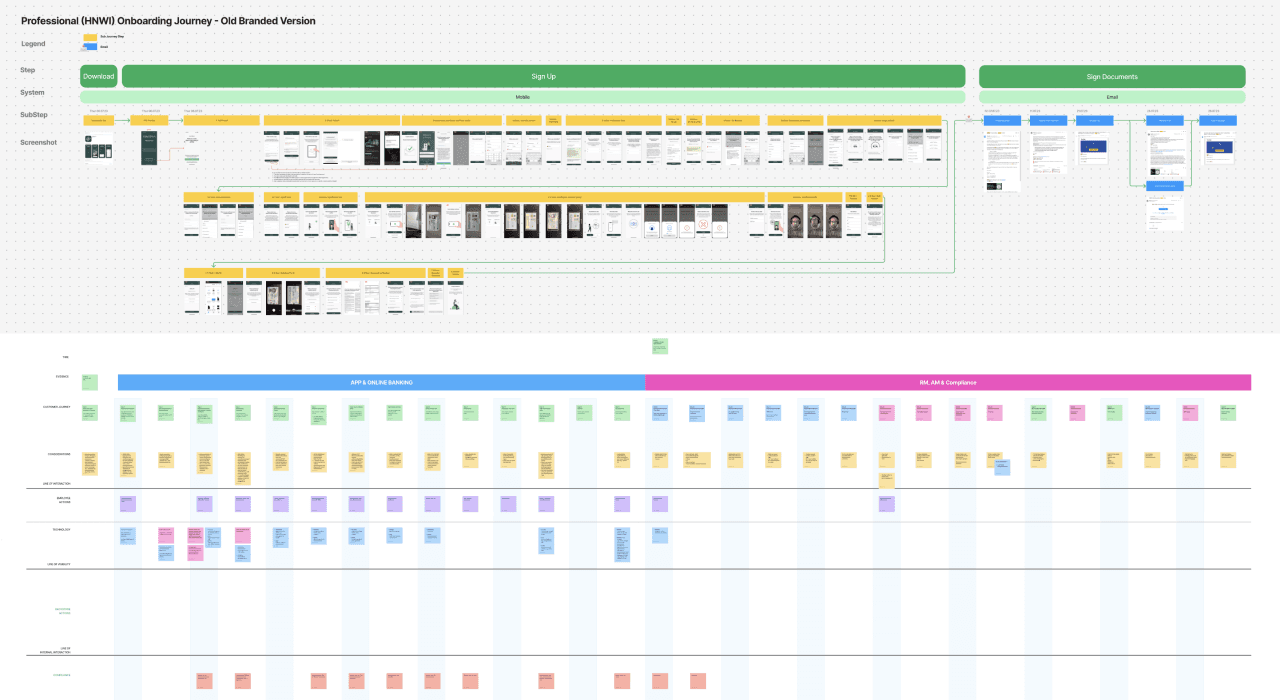
The scope of work covered a 56-screen onboarding flow, with the primary objective of improving onboarding speed and completion. Achieving this required changes not only to the user-facing experience, but also to internal processes across product, compliance, and operations.
Through internal stakeholder interviews and early user testing of proposed changes, a recurring issue emerged.
Problem
Crypto-native users interested in opening an account were hesitant to provide sensitive financial information — particularly wallet addresses and on-chain data — during onboarding.
While this information was required to meet regulatory obligations under FinSA, users perceived these requests as invasive and misaligned with crypto-native norms around privacy and self-custody.
At the same time, delaying the collection of this information in the existing flow had resulted in prolonged back-and-forth between Relationship Managers and clients, often extending onboarding timelines by weeks or months.
The challenge was to meet regulatory requirements without introducing unnecessary friction, while addressing trust concerns at the moments where hesitation occurred.
Solution
Rather than treating trust as a single moment, the solution focused on reinforcing credibility progressively throughout the onboarding journey. We identified specific touchpoints where user hesitation was highest and introduced targeted interventions at each stage.
1. Establishing operating context early
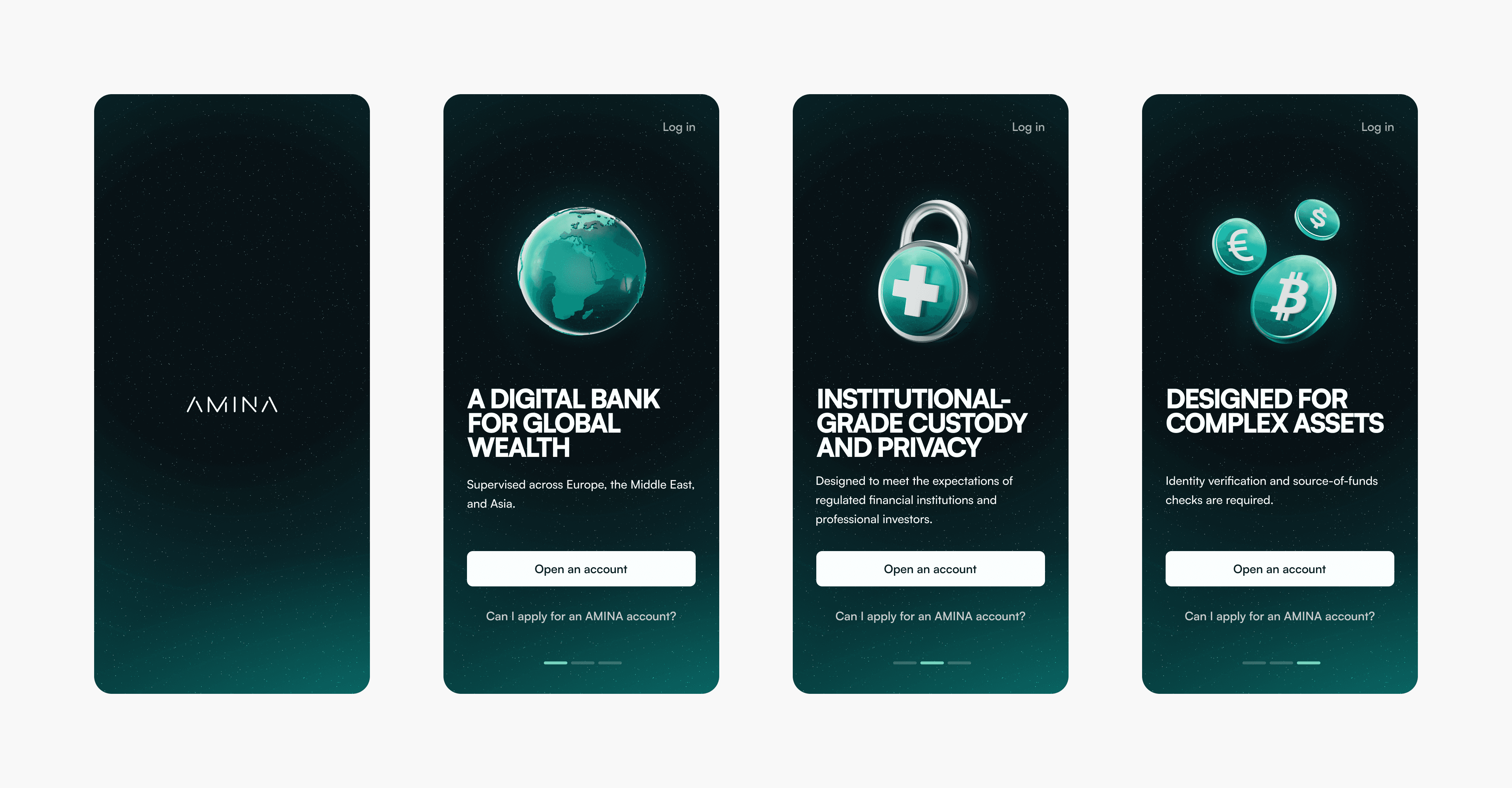
At the start of onboarding, we introduced a short carousel to set expectations before requesting sensitive information.
The content focused on:
AMINA’s positioning as a regulated digital bank operating across multiple jurisdictions
Institutional-grade custody, privacy, and control standards
The requirement for identity verification and source-of-funds checks as part of account opening
The intent was not persuasion, but expectation-setting — establishing legitimacy before introducing compliance-driven friction.
2. Adapting the experience based on crypto sophistication
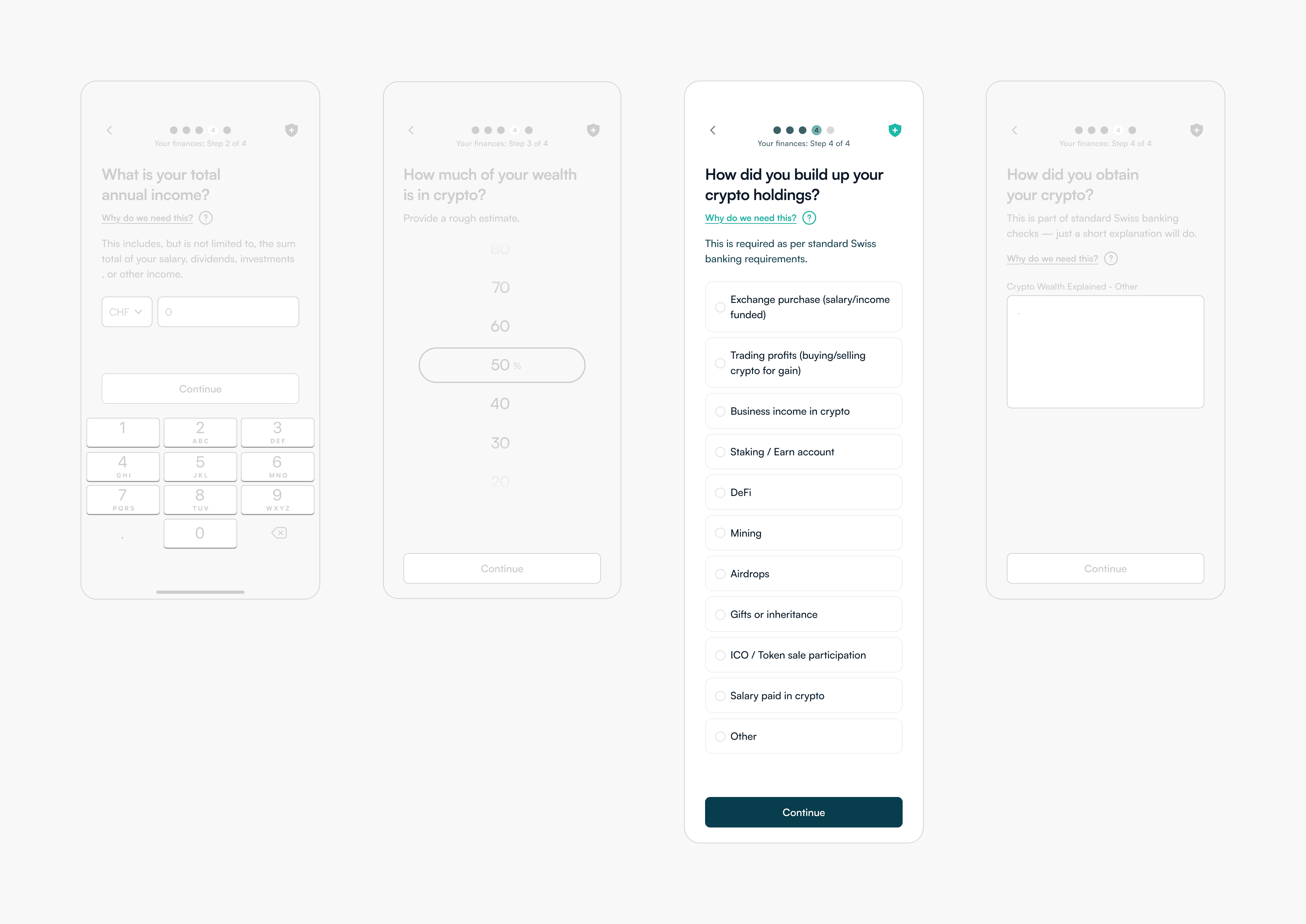
Early in the flow, users were asked how they stored their crypto assets.
This allowed us to distinguish between less sophisticated users and those managing assets via personal wallets or cold storage. Based on the response, messaging and guidance were adapted to better align with the user’s level of familiarity and expectations around control and privacy.
This avoided a one-size-fits-all experience and reduced unnecessary friction for experienced crypto-native users.
3. Reinforcing trust at key moments
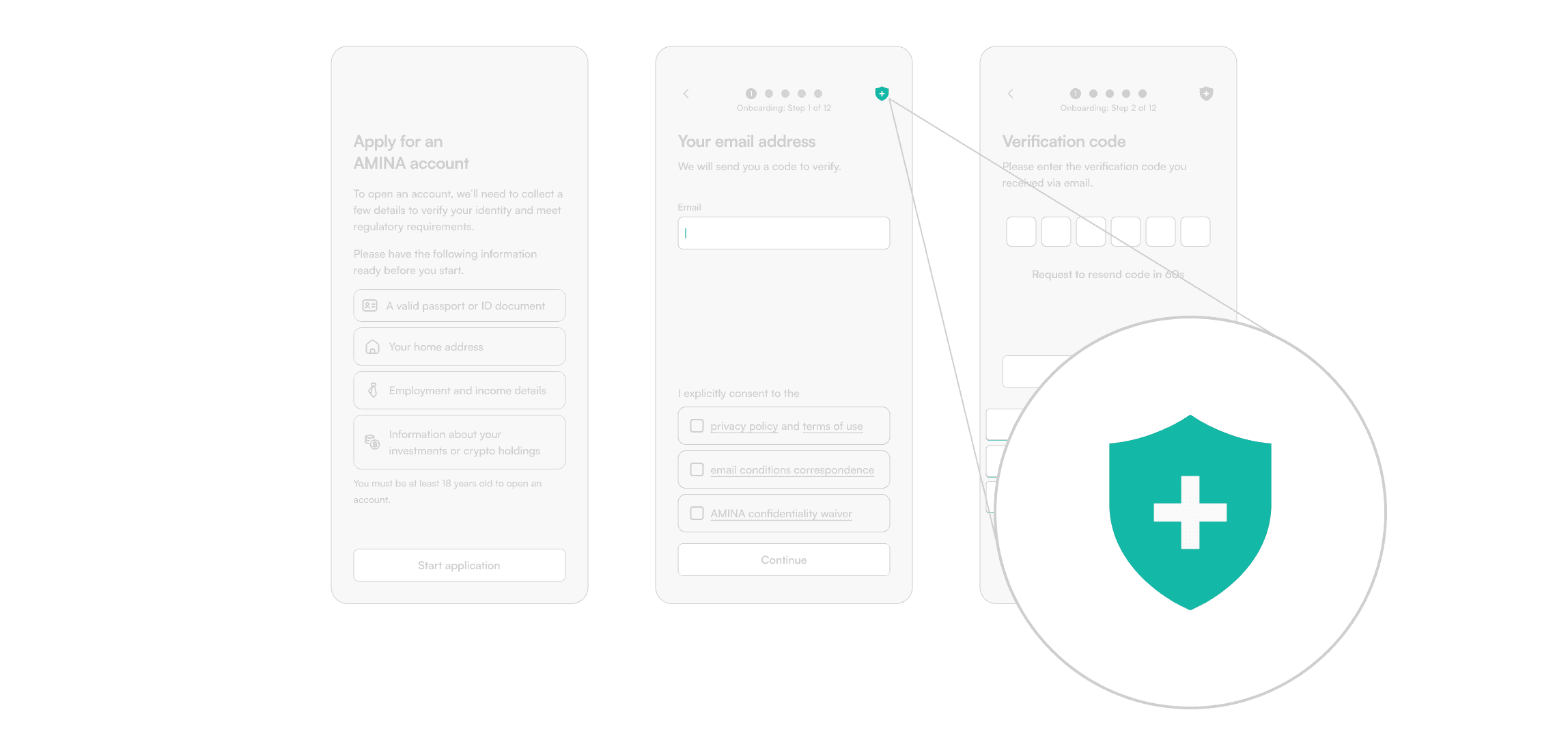
Throughout the onboarding journey, a discreet shield icon was introduced at points where sensitive information was requested.
This icon opened a bottom sheet outlining AMINA’s privacy, custody, and regulatory posture. Rather than repeating assurances in primary UI copy, trust signals were made available contextually and on demand.
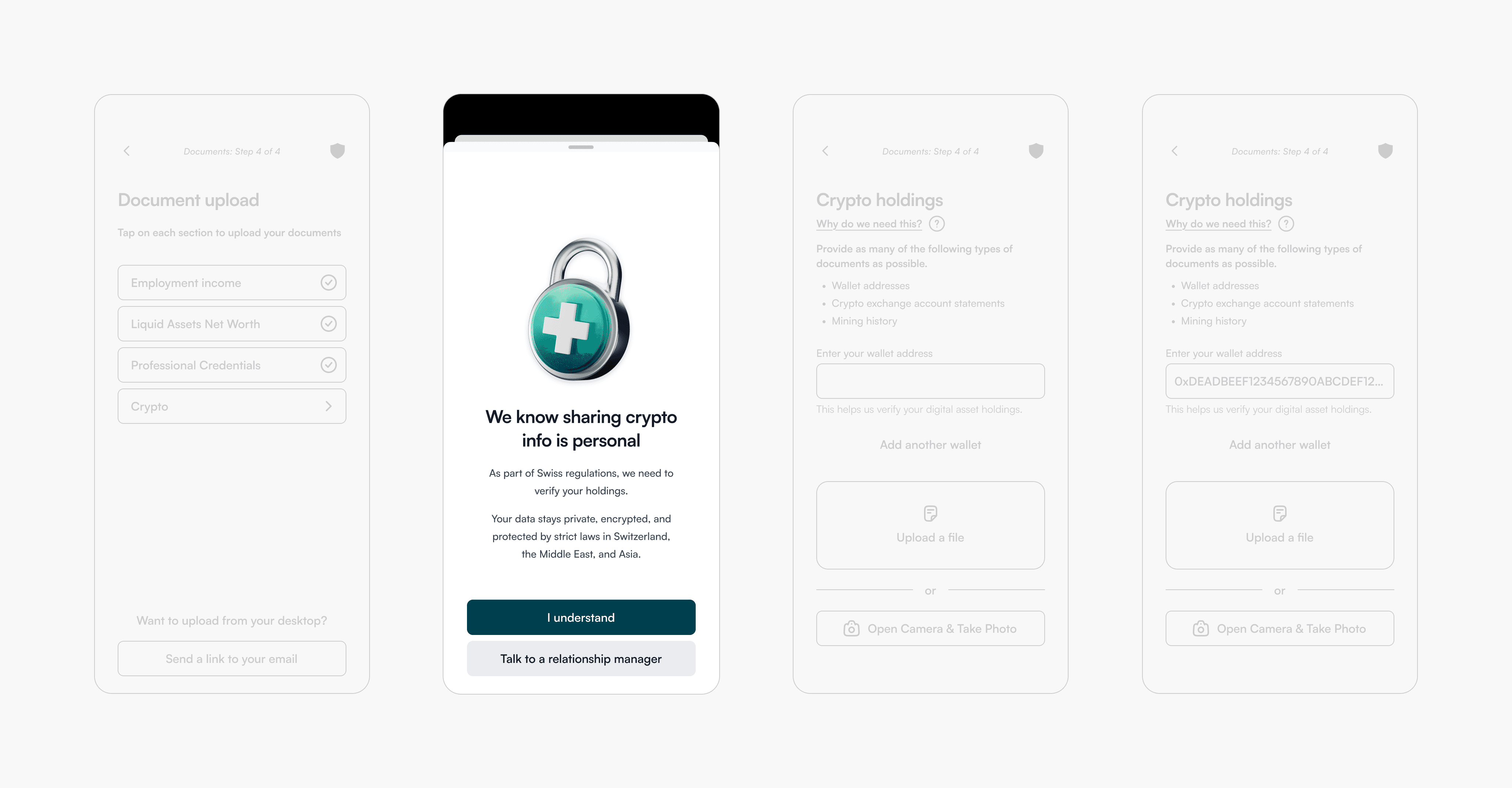
4. Reducing hesitation at the point of wallet disclosure
When users were asked to provide wallet addresses — the highest-friction step in the flow — we combined clear privacy signalling with immediate access to human support.
Immediately before disclosure, we presented a short, explicit message explaining:
why wallet information was required,
how it would be handled,
and how privacy was maintained in line with Swiss banking and regulatory standards.
At the same moment, users were given the option to speak directly with a Relationship Manager.
Internal interviews showed that while some users were reassured by clear privacy explanations alone, others needed confirmation from a human before proceeding. Providing both options reduced abandonment and avoided extended RM–client back-and-forth.
Constraint and trade-off
While wallet disclosure was a clear point of hesitation for crypto-native users, we deliberately chose not to defer this request until after onboarding.
In the existing flow, postponing wallet information led to fragmented compliance data and prolonged RM–client back-and-forth, often extending onboarding timelines by weeks or months.
The design focus was therefore on reducing hesitation at the point of disclosure, rather than delaying it, balancing short-term user discomfort against long-term operational and compliance efficiency.
Design Contributions
Led the end-to-end redesign of a regulated onboarding and identity verification flow, covering 56 screens and associated internal processes.
Partnered closely with Product Managers to define decision logic and automation within onboarding, enabling earlier compliance validation and reducing manual review.
Identified and designed trust-critical moments across the journey, introducing targeted interventions to reduce hesitation around sensitive disclosures.
Collaborated with Compliance, Operations, and Relationship Managers to translate regulatory requirements into clear, user-facing interactions.
Conducted qualitative research with crypto-native users to understand privacy concerns and expectations around self-custody.
Designed adaptive onboarding paths based on user crypto sophistication to avoid one-size-fits-all compliance experiences.
Worked with external 3D agencies to define the visual language for digital assets used in onboarding, establishing standards that carried through the wider product experience.
Learnings
Although the primary goal of the project was to bring onboarding in-house, addressing trust within the flow required close collaboration beyond the product team.
Progress depended on working closely with compliance, operations, and Relationship Managers, as well as conducting direct conversations with crypto-native clients to understand their concerns and expectations.
Designing for regulated environments proved less about removing friction, and more about placing it deliberately — supported by clarity, transparency, and access to human reassurance where it mattered most.